
Rack measurements: U, width, and depth table
· 5 min read
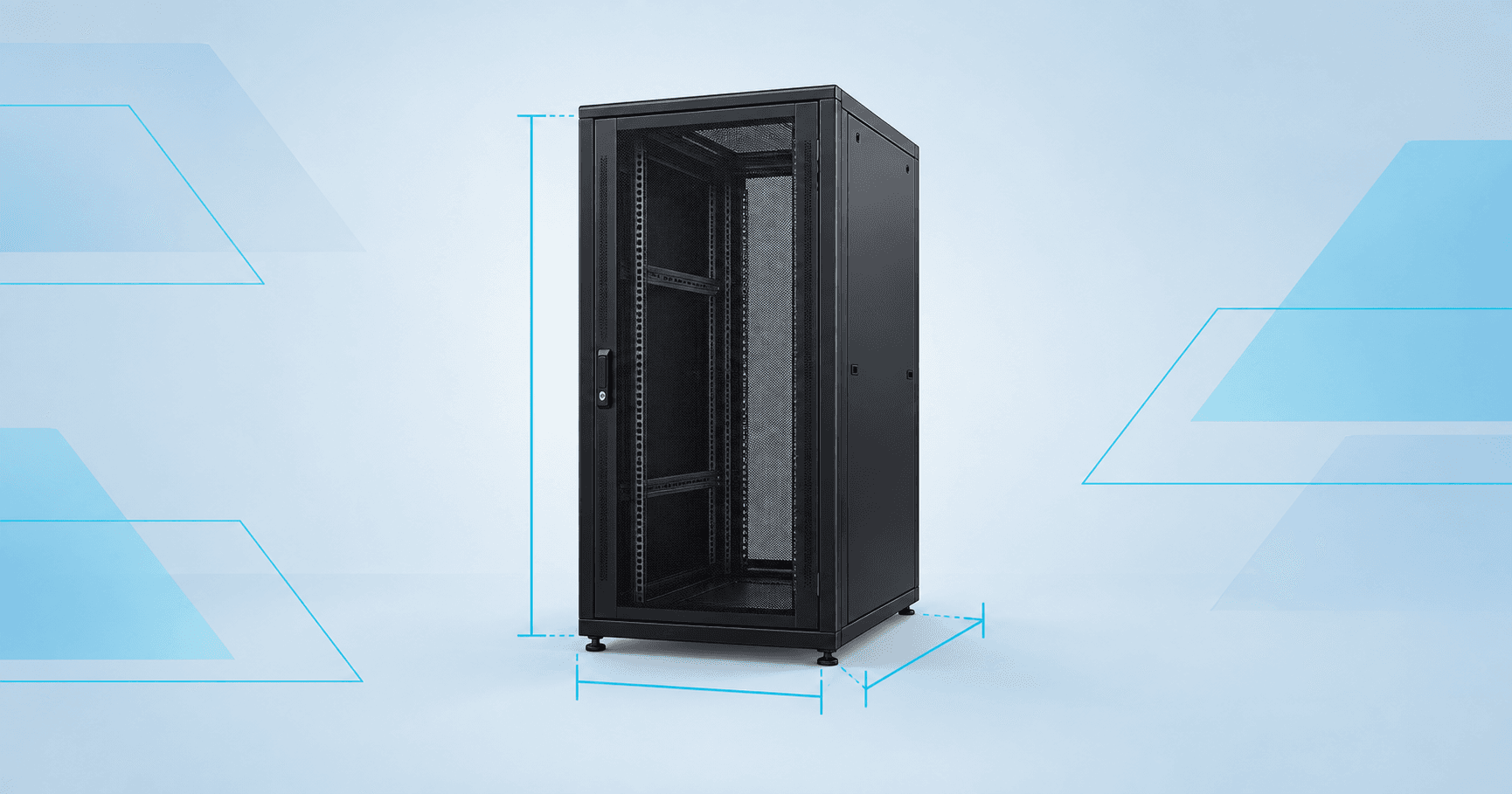
When consulting rack dimensions, several numbers appear: 19 inches, 42U, 600 mm wide, or 1,000 mm deep. Each one describes a different dimension. Understanding them avoids choosing a cabinet that does not fit the equipment or the available space.
Dimension table: from U to millimeters
U expresses the available height for mounting equipment. One unit is 44.45 mm. The table shows the result of multiplying each number of U by that value:
| Mounting height | Equivalent in millimeters | Approximate equivalent in centimeters |
|---|---|---|
| 1U | 44.45 mm | 4.45 cm |
| 6U | 266.70 mm | 26.67 cm |
| 12U | 533.40 mm | 53.34 cm |
| 18U | 800.10 mm | 80.01 cm |
| 27U | 1,200.15 mm | 120.02 cm |
| 37U | 1,644.65 mm | 164.47 cm |
| 42U | 1,866.90 mm | 186.69 cm |
| 47U | 2,089.15 mm | 208.92 cm |
| 48U | 2,133.60 mm | 213.36 cm |
Note: these figures represent mounting space, not the external height of the cabinet. To know whether it fits in a room, an elevator, or under a ceiling, always check the external dimensions in the technical sheet of the specific model.
The equivalent is calculated with a simple operation: number of U × 44.45 mm. For example, 42 × 44.45 = 1,866.90 mm of mounting height. That result is useful for planning the placement of equipment on the rails; the external height of the cabinet will be a different figure that you must check in its technical sheet. Even two models with the same U may have different external characteristics.
What are 19 inches?
19 inches correspond to 482.6 mm and designate the standardized mounting format. They do not mean that the entire cabinet is 482.6 mm wide.
For example, in the Citadex rack cabinet catalog there are models with 600 and 800 mm external width that include support for 19-inch equipment.
When is it useful to look at a larger external width? When the installation needs more lateral space to organize cabling, incorporate certain accessories, or work comfortably. The choice is not resolved by comparing only two numbers: you must also check the internal layout of the model and the actual space in the room.
How to choose the depth?
External depth is another independent measurement. In the standard Citadex range, depending on the model, there are 600, 800, 1,000, and 1,200 mm options. Not all combinations are available in all heights.
Before choosing it, measure the depth of the longest piece of equipment and check the space needed for its connections, cables, doors, and fixing elements. It is also necessary to verify the usable depth between the mounting rails, which may be smaller than the cabinet’s external depth.
A server may fit in the cabinet on paper and still leave little margin to connect power or data cables. If it has mounting rails, also check their adjustment range and the spacing between the front and rear rails. When there are devices with different depths, take the most demanding one as the starting point and review the whole set, not just the most visible unit.
An example to interpret a measurement
A cabinet described as 42U · 800 × 1,000 mm offers 42U of mounting height and measures 800 mm wide by 1,000 mm external depth. Its external height and usable depth must be checked in the corresponding technical sheet.
Imagine that you need to mount several switches, patch panels, and a PDU. First add up the U occupied by each component and note where it will be installed; then verify the available external width and depth. Finally, check the cables, access to the outlets, and margin for future expansions. This way you go from a commercial measurement to a layout that you can review before buying.
Five data points worth gathering before requesting a quotation
- Available space: height, width, and depth of the location, including access doors and access zones.
- Equipment list: U, depth, weight, and planned position of each item.
- Connections: cable entry, power supply, and the space needed to connect and maintain the equipment.
- Mounting conditions: floor-standing or wall-mounted cabinet, load, and intended fixing method.
- Growth: equipment that could be added, with a reasonable margin without oversizing by routine.
The U table helps you understand mounting height. The final selection requires cross-checking it with this data and with the technical sheet of the specific cabinet.
If you tell us which equipment you plan to install and the available space, at Citadex we can help you select a suitable rack cabinet.
References: IEC 60297-3-100 standard for the 19-inch format and Citadex rack cabinet catalog.